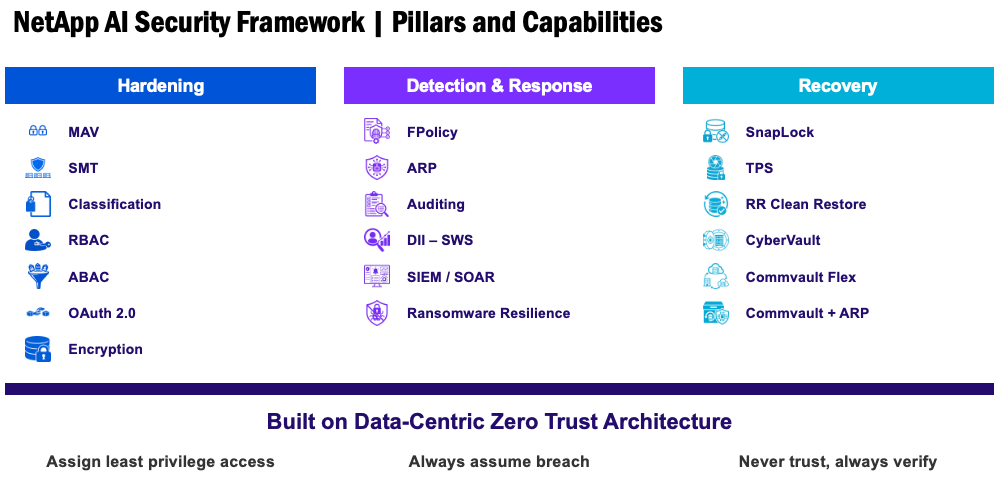
As organizations move from AI experimentation to production-scale deployments, the attack surface expands dramatically. Large language models, AI agents, vector databases, training datasets, and inference pipelines all rely on one critical asset: data. If data is compromised, manipulated, encrypted, or exposed, the value of AI quickly disappears.
This is why theNetApp AI Security Framework is built upon a Data-Centric Zero Trust Architecture with three foundational pillars: Hardening, Detection & Response, and Recovery. Together, these pillars provide a comprehensive approach to protecting AI workloads from cyber threats while ensuring business continuity.
Foundation: Data-Centric Zero Trust
Traditional security approaches focus on securing infrastructure and networks. AI environments require a different mindset because data moves across on-premises systems, clouds, AI pipelines, agents, and model repositories.
The NetApp AI Security Framework embraces three core Zero Trust principles:
- Assign least-privilege access
- Assume breach
- Never trust, always verify
By placing data at the center of security strategy, organizations can protect AI workloads throughout their lifecycle, from training and fine-tuning to inferencing and retrieval-augmented generation (RAG).
Pillar 1: Hardening
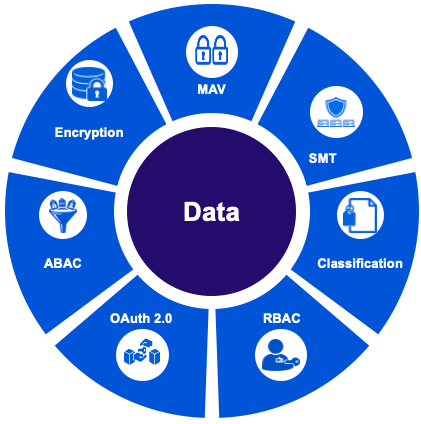
The first step in AI security is reducing the attack surface before threats occur. NetApp hardening capabilities are designed to prevent unauthorized access and ensure that only trusted users, applications, and AI agents can interact with sensitive data.
Key capabilities include:
These controls help establish a secure foundation for AI environments while ensuring compliance and governance requirements are met.
Pillar 2: Detection & Response
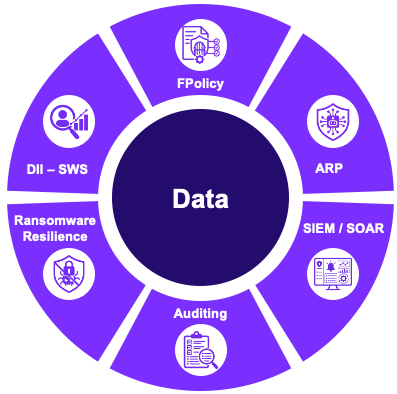
Even the most secure environment must assume an attacker may eventually gain access. The second pillar focuses on rapidly detecting anomalies and automating responses before significant damage occurs.
Key capabilities include:
This pillar provides continuous visibility into user behavior, data access patterns, and emerging threats, enabling security teams to react quickly and confidently.
Pillar 3: Recovery
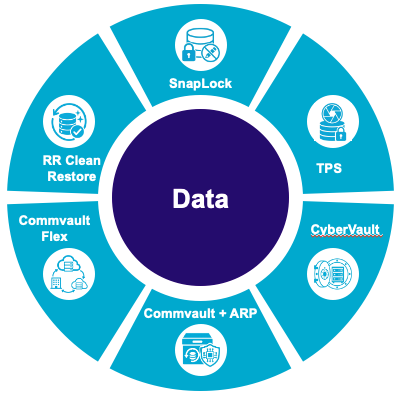
Cyber resilience is ultimately measured by how quickly an organization can recover from an attack. AI environments often contain irreplaceable datasets, vector embeddings, and model artifacts that must be restored rapidly and accurately.
NetApp delivers multiple layers of recovery protection:
These technologies help ensure that organizations can recover AI environments with confidence while minimizing downtime and operational disruption.
Security That Enables AI Innovation
AI adoption should not force organizations to choose between innovation and security. By combining proactive hardening, intelligent threat detection, and rapid recovery capabilities, the NetApp AI Security Framework provides a comprehensive strategy for protecting the data that powers modern AI.
The result is a security architecture that helps organizations confidently deploy AI agents, train models, build RAG applications, and scale generative AI initiatives while maintaining control over their most valuable asset: their data.
In the age of AI, security is no longer just about protecting infrastructure. It is about protecting the data that fuels intelligence. That's exactly what the NetApp AI Security Framework is designed to do.
To finish, here is a summarized view of the Security Framework