Enterprise AI initiatives rarely stall due to model quality alone. More often, they slow down because teams cannot move data fast enough between ingest, preparation, training, inference, and archive tiers. In fact, data mobility, storage placement, and lifecycle control typically account for 80% of the real engineering effort behind any AI initiative. In practice, these factors shape the performance, cost, and operational success of AI far more than most model pipelines account for.
That is where the NetApp AI Architecture becomes especially useful. By aligning storage services to workload behavior, organizations can move datasets and model artifacts through the AI lifecycle with less friction, better GPU utilization, and stronger governance.
This blog outlines a storage-aware AI pipeline built around three NetApp storage Platforms and highlights operations via a representative use case.
Core Principle: Place data on the appropriate storage tier at the right phase of the AI lifecycle, then automate movement between tiers so compute stays busy and governance remains intact.
Where the NetApp Components Fit and why it matters
Component | Function | Value in the Pipeline |
|---|
XCP | High-speed parallel data copy and migration | Accelerates movement from shared prep environments to training tiers |
FlexCache | Remote caching and data locality | Improves access to active datasets across data centers and compute locations |
E-Series with Lustre | Parallel file performance for intensive AI training | Supports high throughput reads, writes, and checkpoint bursts |
ONTAP AFF/AFX | High-performance file and object storage | Supports data prep, active model operations, and inference-serving workloads |
StorageGRID | Durable S3 object storage | Provides a scalable system of record, staging layer, and archive destination |
FabricPool | Automatic cold-block tiering | Reduces hot-tier cost by shifting inactive data to object storage |
The NetApp AI Storage Architecture
The NetApp AI Storage Architecture organizes AI data services into three complementary storage platforms.
Primary Platform | Best-Fit Role |
|---|
E-Series with LustreFS | Extreme-performance parallel storage for large-scale training and checkpoint operations |
ONTAP AFF/AFX | High-performance file and object storage for data prep, active training, fine-tuning, and inference |
StorageGRID | Durable, scalable S3 object storage for ingestion, staging, data lake operations, and long-term archive |
Each stage serves a distinct purpose. Stage 1 is optimized for throughput and parallel I/O. Stage 2 supports flexible enterprise AI operations with file and object access as well as high-performance storage. Stage 3 provides durable capacity for system-of-record storage, rehydration, and compliance retention.
Why Storage-Aware Pipelines Matter
AI pipelines are not a single storage problem. They are a sequence of different access patterns.
- Raw ingestion favors scalable object storage.
- Data engineering and feature preparation benefit from flexible, shared file services.
- Distributed model training demands extreme throughput and low-latency parallel reads and writes.
- Inference requires fast access to model weights, embeddings, and retrieval data.
- Compliance and cost control require cold data demotion and durable retention.
Without explicit orchestration across these stages, organizations end up overprovisioning expensive storage, underutilizing GPUs, and relying on fragile manual data copy processes.
A 7-Phase Orchestrated AI Pipeline
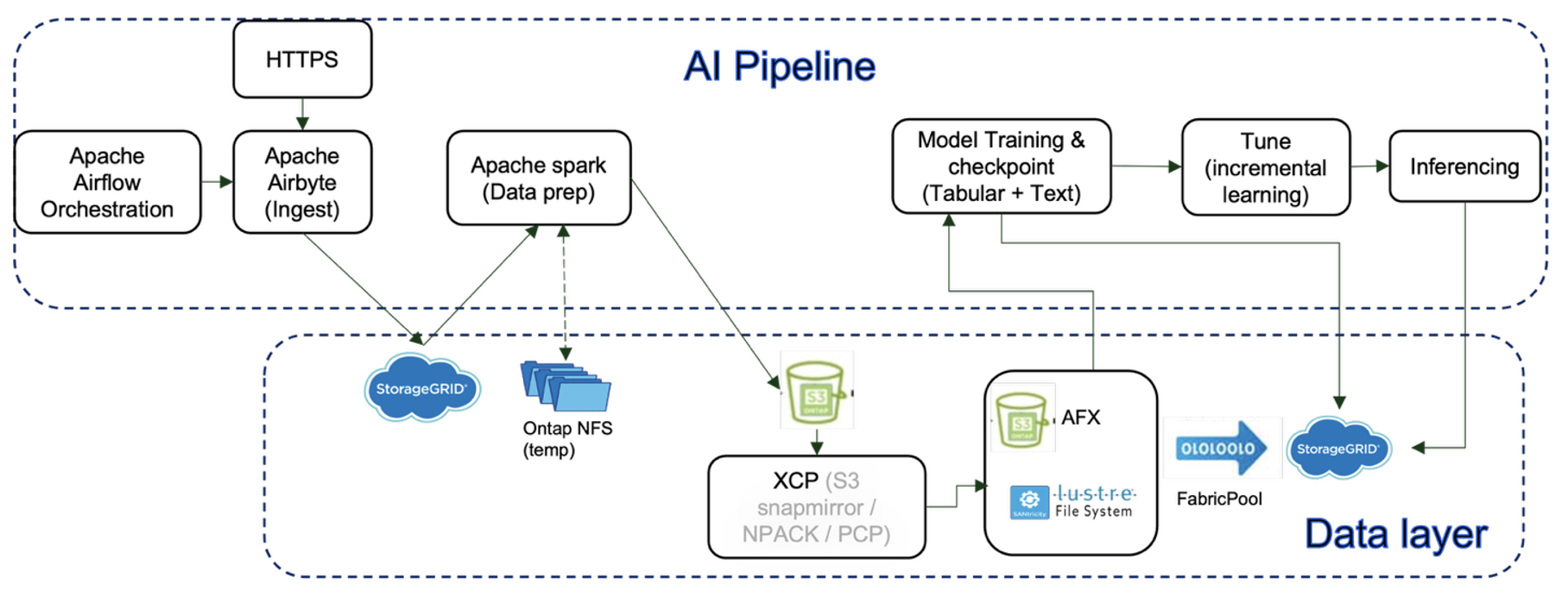
A practical implementation uses Apache Airflow to coordinate data movement and lifecycle transitions across the storage platforms. A parameterized DAG (Directed Acyclic Graph) can drive copy destinations, dataset versions, runtime configuration, and archival actions without requiring application rewrites.
- Ingestion: Raw structured and unstructured data lands in StorageGRID using S3-based ingest pipelines. We leverage Apache Airbyte (or NiFi).
- Preparation : Spark or similar engines clean, normalize, and partition data. This is followed by staging intermediate artifacts on ONTAP NFS volumes, and splitting the data (train, validation, inference) into iceberg/delta tables.
- Stage training data: NetApp XCP moves curated datasets into ONTAP AFF/AFX S3 or active E-Series LustreFS storage for GPU access.
- Large-scale training: GPU clusters train against E-Series with Lustre or ONTAP-based high-performance tiers through s3.
- Fine-tuning: Incremental model updates continue on active ontap storage adjacentto enterprise datasets.
- Inference and retrieval: Model artifacts, embeddings, and vector data are served from low-latency tiers, with optimalnear-GPU KV caching.
- Archive and tiering: Final outputs, logs, checkpoints, and cold datasets move back to StorageGRID, with FabricPool or manual archival handling transparent cold-data demotion where appropriate.
Use Case: Storage-Aware AI Pipeline Across Enterprise and Cloud Architectures
- Requirements
- Multi-Tenant Isolation & Security: Enforce strict data segregation and access policies across departmental tenants, business units, or cloud customers without introducing cross-tenant I/O contention.
- GPU-Saturating Training Throughput: Deliver sustained high-throughput, low-latency access to training datasets using GPUDirect Storage (GDS) over RDMA to keep high-density GPU compute clusters fully saturated.
- Low-Latency Checkpoint Commit: Rapidly write large, multi-terabyte model checkpoints to persistent storage, minimizing GPU pause times during synchronous training iterations.
- Automated Data Mobility & Staging: Eliminate manual script-based copies (cp, rsync) by deploying policy-driven, parallelized dataset transfers between staging environments and training clusters.
- Cross-Datacenter Dataset Locality: Extend active read volumes seamlessly from core enterprise data centers to isolated AI factorieswithout full-copy replication delays.
- AI-Native Serving & RAG Performance: Support optimizedquery latencies for vector databases, embedding stores, and RAG pipelines while offloading key-value (KV) caches during disaggregated inference.
- Control-Plane Metadata Stability: Protect cluster orchestration metadata (Slurm state, user home directories, job configurations) from heavy I/O contention during training runs.
- Automated Lifecycle Governance: Transparently demote cold datasets, retired checkpoints, and historical logs to durable object storage to satisfy 3-2-1-1-0 compliance and lower TCO.
- Solution: NetApp AI Architecture & Product Integration
The solution integrates NetApp products and data mobility engines across the 3 AI storage platforms, orchestrated by a parameterized Apache Airflow DAG (dag_run.conf).
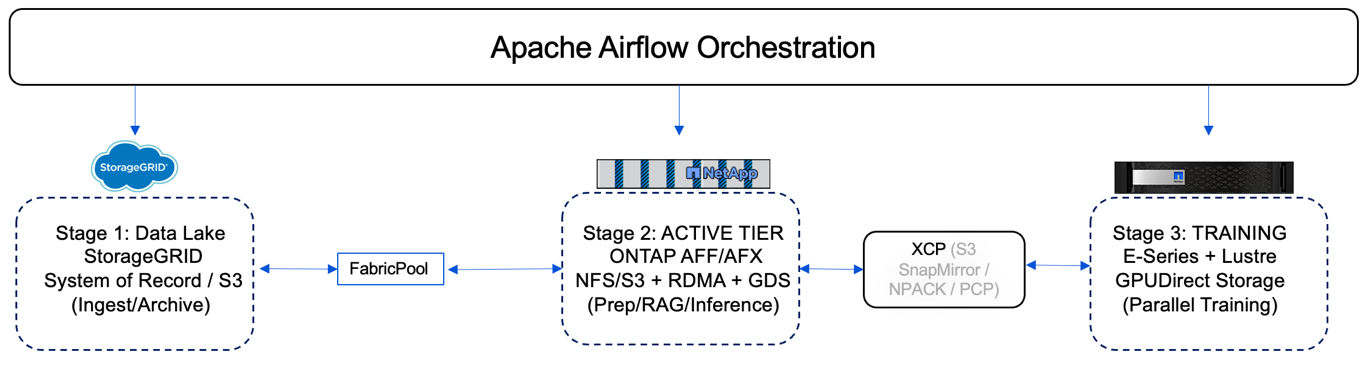
- Storage Stage Mapping
- Data Lake & System of Record (NetApp StorageGRID S3)
- Role: System-of-record object store for raw ingestion, dataset preparation, and cold archival.
- Functionality: Features S3 Select, metadata tagging, WORM/Object Lock immutability, and multi-versioning. Serves as the cold foundation where raw unstructured data lands and where completed checkpoints are automatically retired.
- Active Performance & Serving Tier (NetApp ONTAP AFX / ONTAP S3)
- Role: High-performance, multi-protocol (NFS/POSIX and S3) file and object storage for data staging, fine-tuning, inference serving, and RAG pipelines as well as model training.
- Functionality:
- Multi-Tenancy: Configured with dedicated ONTAP Storage Virtual Machines (SVMs) to guarantee namespace and resource isolation per department/tenant.
- Inference & RAG: Delivers low-latency retrieval for vector databases (Milvus, Faiss) and Apache Iceberg/Delta Lake tables over ONTAP S3 with RDMA.
- Control-Plane Protection: Dedicated ONTAP NFS volumes isolate Slurm control files, code repositories, and user home directories from training I/O storms.
- Extreme Parallel Training Tier (NetApp E-Series + LustreFS)
- Role: Extreme-throughput, ultra-low latency parallel file system engineered for distributed GPU training and high-frequency checkpointing.
- Functionality: Connects directly to GPU compute nodes via GPUDirect Storage (GDS) and RDMA, delivering multi-terabyte checkpoint write speeds and saturating dense GPU clusters (e.g., NVIDIA DGX SuperPODs).
- NetApp Data Mobility & Tiering Engines
- NetApp XCP: Multi-threaded, parallelized data mobility engine replacing serial transfers. Executes high-speed dataset copies and verification between ONTAP NAS (NFS) staging volumes and Stage 1 (E-Series LustreFS) or Stage 2 (ONTAP S3) training tiers.
- NetApp FlexCache: Dynamically extends source ONTAP volumes across data centers to remote AI compute facilities, providing low-latency local read access to datasets without manual pre-staging or full-copy replication.
- NetApp FabricPool: Automated, policy-driven storage tiering that demotes inactive primary blocks from Stage 2 ONTAP AFX volumes to Stage 3 StorageGRID object storage without changing application or pipeline logic.
3. Benefits
- Maximized Compute Efficiency: Minimizes GPU idle time during distributed training and checkpointing windows through GPUDirect Storage over RDMA and high-speed parallel file access and High-performance object storage.
- Enterprise-Grade Multi-Tenancy: Enforces strict tenant isolation at the ONTAP SVM layer, enabling multiple departments or customers to run concurrent AI workloads safely on shared infrastructure.
- Policy-Driven Automated Mobility: Replaces manual script execution with automated, observable Airflow DAG workflows incorporating XCP transfers, FlexCache replication, and FabricPool tiering.
- Optimized Storage TCO: Lowers overall capital and operational expenditure by keeping active datasets on high-performance flash (Stages 1 & 2) while automatically tiering cold data and checkpoints to scale-out object storage (Stage 3).
- Unified Architecture for Training & Inference: Eliminates storage silos by supporting the entire AI lifecycle—from high-throughput file-based training runs to low-latency vector search and disaggregated RAG serving—on a single, integrated platform.
The NetApp AI Architecture reference implementation is available as a complete software package, including Apache Airflow automation DAGs, deployment scripts, storage platform configuration templates, and validation artifacts for end-to-end pipeline testing.
The solution details is here -
https://docs.netapp.com/us-en/netapp-solutions-ai/infra/ai-pipeline-overview.html
To request the package, engage on deployment guidance, or submit technical feedback, reach out to the NetApp AI & Data Mobility team directly via email 📧ng-data-mobility-in-ai-pipeline@netapp.com. The team supports software package requests, architecture validation, deployment troubleshooting, and technical inquiries related to integrating NetApp storage tiers into production AI pipelines.
