Enterprises running large-scale analytics platforms need more than a passive backup repository. A modern Cloudera disaster recovery architecture must protect petabytes of data, preserve metadata consistency, support immutable retention, and remain operationally useful during a disaster. Based on the attached solution material, this technical blog explains a hybrid NetApp architecture that combines a high-performance flash tier with scalable object storage to deliver an offline backup and active recovery platform for an 18PB Cloudera and private cloud environment.
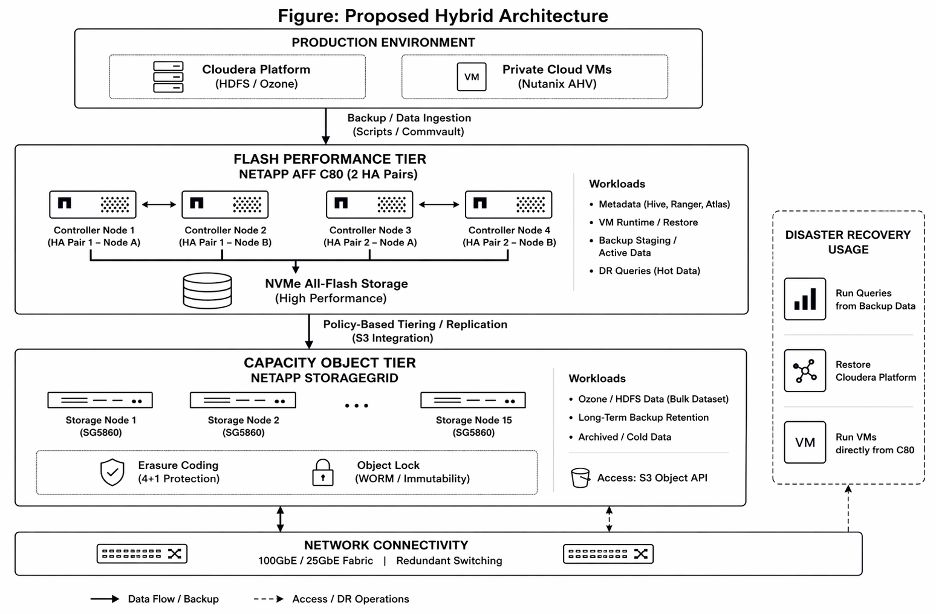
Figure 1: Enterprise backup and DR architecture concept for Cloudera, virtual machines, NetApp ONTAP, and StorageGRID.
Executive Summary
The proposed architecture uses a tiered data protection model. NetApp AFF C80 provides the performance layer for latency-sensitive workloads, backup ingestion, metadata services, and VM recovery. NetApp StorageGRID provides the capacity layer for large-scale S3-compatible object storage, long-term retention, and immutable backup copies using object lock.
The design targets approximately 18PB usable backup capacity without depending on storage efficiency assumptions for baseline sizing. It separates workloads by protocol and access pattern: object workloads are placed on StorageGRID, file and NFS services are delivered through ONTAP, and VM recovery workloads use the flash tier for predictable performance.
Business and Technical Requirements
- Protect the full Cloudera platform, including HDFS/Ozone data, metadata, configurations, workflows, Ranger, Atlas, Hive Metastore, and security components.
- Provide multi-protocol access, including S3, NFS, CIFS/SMB, and optional block or secure file transfer services.
- Deliver immutable retention using WORM or object lock to reduce ransomware and malicious deletion risk.
- Enable active use of backup data at the disaster recovery site, including analytical query execution and direct VM recovery.
- Support high-speed backup and restore operations over 100GbE and 25GbE network fabrics.
- Provide enterprise management, monitoring, reporting, alerting, LDAP integration, auditing, and restoration runbooks.
Reference Architecture
The architecture is built around two complementary tiers:
- Performance tier: NetApp AFF C80 all-flash systems running ONTAP, deployed as a 4-node cluster across 2 HA pairs.
- Capacity tier: NetApp StorageGRID SG5860 appliances with SG1200 service/load-balancer appliances for S3-scale object storage.
In this model, backup data lands first on the AFF C80 tier when low latency, high throughput, or direct recovery is required. Bulk Cloudera data and long-retention copies are then tiered to StorageGRID through S3-based lifecycle policies.
Performance Layer: NetApp AFF C80
- 4-node ONTAP cluster using 2 HA pairs.
- NVMe-based capacity flash for low latency and predictable recovery performance.
- Used for Cloudera metadata, backup staging, VM backup repositories, and DR runtime workloads.
- Supports NFS, SMB/CIFS, and block services where required.
- Provides ONTAP data services such as snapshots, replication, encryption, RBAC, auditing, ransomware protection, and secure administration.
Capacity Layer: NetApp StorageGRID
- Scale-out object storage using SG5860 storage nodes.
- S3-compatible object API for Cloudera Ozone/HDFS backup datasets and long-term retention.
- Erasure coding for durability and capacity efficiency.
- Object Lock/WORM support for immutable backup copies.
- Designed for billions of objects, large-scale data lakes, archive repositories, and object-based analytics.
Workload Placement Strategy
Workload | Access Pattern | Recommended Tier | Reason |
Cloudera Ozone / HDFS bulk data | High capacity, scan-heavy, object-oriented | StorageGRID | Scales to petabytes and billions of objects with S3 access and object lifecycle management. |
Hive, Ranger, Atlas, and metadata services | Small-file, random, latency-sensitive | AFF C80 | Low latency and high IOPS improve query planning, authorization, and metadata operations. |
Backup staging area | Write-heavy during backup windows | AFF C80 | Flash absorbs backup bursts before lifecycle tiering to object storage. |
VM backup repository | Sequential backup, rapid restore | AFF C80 | Supports fast recovery and direct VM execution during DR scenarios. |
Long-term immutable retention | Infrequent access, compliance retention | StorageGRID | Object Lock provides WORM-style protection against deletion and ransomware. |
DR analytical queries | Read-intensive, parallel scans | AFF C80 + StorageGRID | Hot data and metadata remain on flash while cold datasets are accessed from S3. |
Backup and Restore Methodology
Cloudera Protection
Cloudera backup requires more than copying data files. A recoverable environment must capture data and metadata together so that Hive tables, Ranger policies, Atlas lineage, Ozone/HDFS namespaces, workflows, and security material remain consistent. The recommended method is to combine native Cloudera mechanisms, scripted orchestration, and NetApp storage services.
- Capture HDFS/Ozone datasets, table metadata, authorization policies, cluster configurations, and workflow definitions.
- Use point-in-time coordination to avoid mismatch between datasets and metadata services.
- Stage high-throughput backup streams on AFF C80.
- Move long-term protected copies to StorageGRID with lifecycle policies and object locking.
Virtual Machine Protection
Critical private cloud virtual machines should be protected using enterprise backup software integrated with NetApp storage. Full and incremental VM backups are written to the AFF C80 tier so that recovery operations can restore VMs rapidly or, where supported, run them directly from backup storage during a disaster.
Restore Workflow
- Provision or validate the DR-side Cloudera infrastructure and supporting services.
- Restore cluster configuration, security components, Hive Metastore, Ranger, Atlas, and workflow definitions.
- Recover bulk datasets from StorageGRID and hot/metadata datasets from AFF C80.
- Validate namespace integrity, table availability, authorization policies, and sample analytical queries.
- Restore or boot critical VMs from the AFF C80 recovery tier.
- Document results in a formal runbook and repeat validation through scheduled DR tests.
Security, Immutability, and Ransomware Resilience
The architecture uses a defense-in-depth model aligned to zero-trust data protection principles. StorageGRID Object Lock protects backup objects from modification or deletion during the retention period. ONTAP adds snapshots, encryption, RBAC, secure administration, auditing, and ransomware detection capabilities on the performance tier.
- Data at rest: ONTAP supports NetApp Volume Encryption, NetApp Aggregate Encryption, and NetApp Storage Encryption. StorageGRID encrypts objects with AES-256 software-based encryption.
- Data in flight: SMB encryption, NFS Kerberos privacy, IPsec, TLS, and encrypted cluster peering can be used based on protocol requirements.
- Administrative security: RBAC, MFA, secure SSH, audit logging, LDAP integration, and multi-admin verification reduce privileged-access risk.
- Ransomware resilience: ONTAP autonomous ransomware protection, immutable snapshots, SnapLock, and StorageGRID Object Lock help preserve clean recovery points.
Operational Design Considerations
Design Area | Recommendation |
Network | Use redundant 100GbE/25GbE fabrics for backup ingestion, object access, replication, and recovery traffic. |
Protocol separation | Keep S3 object workloads on StorageGRID, file workloads on ONTAP NAS, and VM/block workloads on the flash tier. |
Lifecycle management | Apply policies that move aged or cold data from AFF C80 to StorageGRID while retaining metadata and hot datasets on flash. |
Monitoring | Use centralized dashboards, capacity forecasting, alerting, audit logs, and backup job reporting. |
Runbook | Maintain tested procedures for Cloudera recovery, VM restoration, object-lock validation, and DR query testing. |
Why This Architecture Matters
The key architectural decision is to avoid treating backup storage as a single undifferentiated capacity pool. Cloudera metadata, backup staging, and VM recovery require predictable performance; bulk datasets and compliance retention require scale and durability. By separating these concerns, the platform can deliver both cost-efficient petabyte-scale protection and active recovery capability.
Takeaway: The most resilient DR design is one that can be restored, validated, queried, and operated before and after a disaster occurs. Combining AFF C80 and StorageGRID enables you to protect data, preserve consistency, and actively use backup copies when business continuity depends on them.
Conclusion
A hybrid NetApp platform provides a practical foundation for enterprise-scale Cloudera backup and disaster recovery. AFF C80 delivers the low-latency performance needed for metadata, staging, and VM recovery, while StorageGRID delivers durable, immutable, S3-native capacity for long-term data protection. Together, they create a unified data fabric that supports cyber resilience, operational readiness, and scalable growth for modern analytics environments.
Special thanks and full credit go to Ahmed Al-Nabhani for the opportunity to collaborate with him on this work and for his valuable contributions. For any future questions or support, please feel free to contact Ahmed at Ahmed.Al-Nabhani@netapp.com or me at nkarthik@netapp.com