New ONTAP MCP: AI that Modernizes Your Storage Operations
In the last post, we talked about a shift in how teams interact with storage data.
With NetApp® Harvest MCP (Model Context Protocol), metrics stopped being something you had to hunt for. Instead, they became conversational — accessible through natural language, across NetApp ONTAP®, StorageGRID®, E‑Series, and even Cisco environments. Observability began to answer back.
But insight alone isn’t the end goal.
The real unlock happens when AI can move from understanding what’s happening to doing something about it.
That’s where the ONTAP MCP server comes in.
The Missing Link: Turning Insight into Operations
Today, we’re introducing the ONTAP MCP Server — the piece that lets AI move from observing your storage to actually operating it. It is major milestone – AI can now create and manage volumes for you, across the entire storage stack.
This MCP exposes operations, meaning that MCP‑compatible AI clients can now perform real ONTAP administrative actions. These actions include NAS provisioning, including the creation and management of volumes, shares, and exports.
These ONTAP administrative actions are executed through structured, validated tools — not ad‑hoc scripts or brittle automation. The ONTAP MCP server serves as the operational counterpart to Harvest MCP.
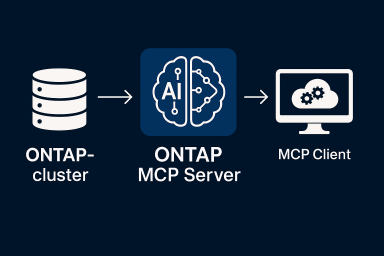
This marks the shift from AI that observes to AI that operates.
MCP: Why This Matters for Operations
The ONTAP MCP server is powered by the intelligence layer — just at the control plane. For storage teams, MCP eliminates the gap between observing storage and operating it. It brings policy-guided automation to routine tasks like provisioning and protection.
With ONTAP MCP server:
- AI clients don’t guess how to manage storage
- They invoke explicit tools, each mapped to a well‑defined ONTAP REST API workflow
- Parameters are validated, actions are predictable, and responses are structured
In other words, MCP gives AI hands — but with guardrails.
This is the moment MCP stops being analytical and starts being operational - moving from AI-powered insights to AI-powered operations across the intelligent data infrastructure.
What ONTAP MCP Server Can Do Today
This initial release focuses on NAS provisioning workflows, where day‑to‑day operational toil is most common.
MCP‑compatible assistants such as Claude Desktop or GitHub Copilot can directly interact with ONTAP storage systems. They can perform foundational tasks, such as:
- Create, manage and export ONTAP NFS volumes
- Configure and update export policies
- Handle access control and lifecycle operations
These aren’t simulations or recommendations. The MCP server translates each request directly into ONTAP REST API calls. Then it returns normalized results that AI clients can chain into multi‑step workflows.
If Harvest MCP made storage health conversational, ONTAP MCP server makes storage administration actionable.
How It Works: Simple, On Purpose
The ONTAP MCP server is intentionally straightforward.
Under the hood, it’s a small Go‑based service that:
- Exposes and hosts MCP tool schemas for ONTAP administration
- Each tool corresponds to a well-defined administrative action
- Validates parameters and enforces guardrails
- Routes requests to one or more ONTAP clusters via REST APIs
Multiple clusters can be managed through a single MCP endpoint, allowing AI clients to operate consistently across environments.
There are some key elements to understand:
- MCP clients (Claude Desktop, GitHub Copilot, IDEs) talk to the ONTAP MCP server using MCP’s standard client/server pattern.
- The ONTAP MCP server hosts tool schemas, performs parameter validation/guardrails, and routes requests to the right cluster
There’s no new abstraction layer to learn — just a clean bridge between MCP tools and ONTAP’s existing APIs.
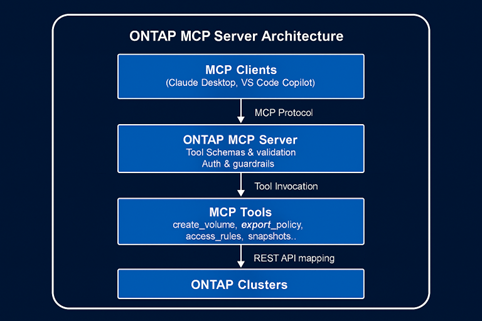
Operational Architecture: Binding MCP Tools to ONTAP REST Services
Getting Started with ONTAP MCP server
If you’re already comfortable running containers and managing ONTAP credentials, getting started is intentionally lightweight.
However, there are some prerequisites that must be in place first.
- NetApp ONTAP cluster(s) with admin credentials
- Docker environment for running the MCP server
- Network connectivity from the MCP server to your ONTAP cluster(s)
Step-by-step
- Start the ONTAP MCP Server
docker run -d \
  --name ontap-mcp-server \
  -p 8083:8083 \
  -v /path/to/your/ontap.yaml:/opt/mcp/ontap.yaml \
  ghcr.io/netapp/ontap-mcp:latest \
  start --port 8083 --host 0.0.0.0
Example ontap.yaml file:
Pollers:
cluster1:
addr: 10.0.0.1
username: admin
password: password
use_insecure_tls: true
- Configure your mcp.json
{
  "servers": {
    "ontap-mcp": {
      "type": "http",
      "url": http://your-server-ip:8083
    }
  }
}
3. Use a task prompt in the chat view:
“create a volume of 5 gb with name demo_vol01 in svm demo_svm01 and aggregate agg_data_tme_1”
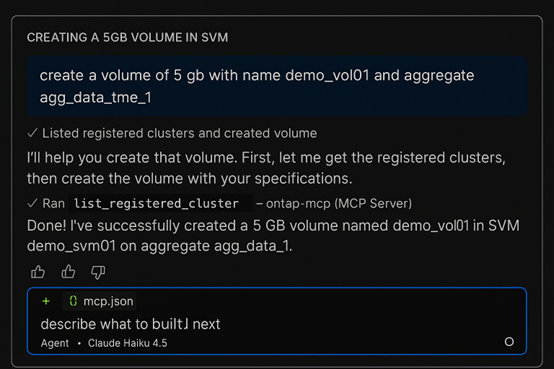
The AI handles the orchestration; ONTAP MCP ensures the operation is executed safely and predictably.
Using Harvest MCP and ONTAP MCP Together
These two MCP servers are designed to complement each other.
- Harvest MCP answers questions like:
“Which volumes are nearing capacity?”
“Where is latency trending up?”
- ONTAP MCP acts on those answers:
“Create additional capacity.”
“Adjust exports.”
Same MCP model. Same conversational flow. One observes; the other operates.
This is where AI‑driven storage starts to feel cohesive rather than experimental.
Closing thoughts
What’s next
This is the moment MCP stops being analytical and starts being operational.
By extending the Model Context Protocol (MCP) from observability to full operational control, it allows AI assistants to interact with ONTAP through validated, standards-aligned tools that ensure safety, consistency, and predictability.
ONTAP MCP server is currently in early access, and that’s by design.
If you want to help shape that path, now is the moment to get involved.
Continue the Series
If you haven’t already, start with Part 1 of this series, where we introduced Harvest MCP and the shift toward conversational observability across NetApp storage environments.
👉 Read Part 1: “Harvest Speaks: New AI-Ready Observability Across All Your NetApp systems - NetApp Community”
Get involved and stay connected
- Get involved and star ONTAP GitHub repository
- The most impactful ways to support the project is simply to star it
- Starring helps signal its importance, increases visibility, and strengthens the ecosystem around the project
- Read the ONTAP MCP server documentation
- Experiment with the early access workflows
- Join joining the communities in Discord and GitHub Discussions
- They're terrific ways to collaborate, learn, and stay informed


