I am pleased to announce the general availability of NetApp Backup and Recovery for Kubernetes. This is a significant milestone in our investment to provide integrated data protection for containers and virtual machines on Kubernetes and includes support for Red Hat OpenShift and OpenShift Virtualization. Guided by feedback from our Preview customers, Backup and Recovery protects both containerized applications including AI/ML workloads, and virtual machines as customers migrate to a modern virtualization platform.
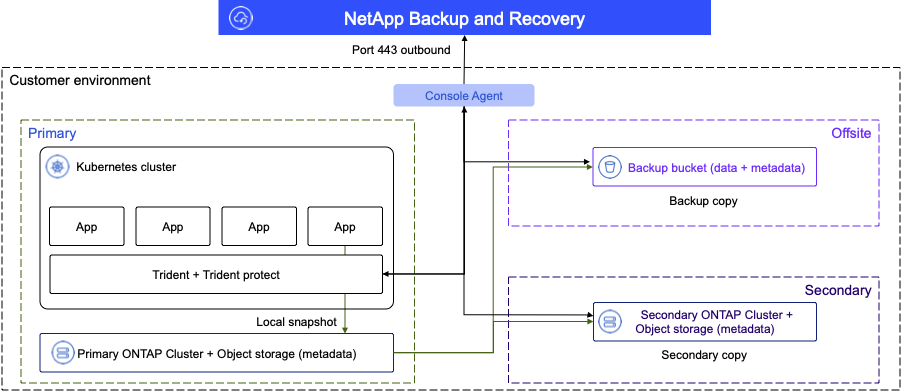
Here’s how NetApp Backup and Recovery helps storage and backup admins address common Kubernetes and OpenShift Virtualization protection challenges:
Operational Complexity
As we worked with Preview customers, one thing they shared is that backing up and restoring Kubernetes workloads is complex with no clear solution. Customers are trying to retrofit their existing data protection solutions by requesting features from the vendors providing their current solution. This is creating a backlog of requests that won’t be delivered for another 12-18 months. Alternatively, Backup and Recovery delivers a Kubernetes native, application aware and consistent data protection solution today. This is possible by leveraging the robust Kubernetes data protection available with NetApp Trident.
Storage and Backup administrators can continue using NetApp Console as a fleet manager for ONTAP systems and to protect their Kubernetes based workloads running across one or more clusters and across more than one site. In addition to the GUI, NetApp Backup and Recovery adds support for Kubernetes Custom Resources (CR) based operations for configuring applications and performing backups and restores using multiple backup architectures like 3-2-1 protection, without ever having to log into the Console.
Meeting your Recovery Point and Recovery Time Objectives
Another insight we gained from the Preview was our customer’s inability to meet their backup windows with their existing data protection solutions. This was either due to relying on open source data movers like restic and kopia, which do support incremental backups, but have to compute the increments by rescanning and recalculating the 64 byte blocks or running into resource limits for those restic and kopia pods, which lead to really slow and unpredictable backups.
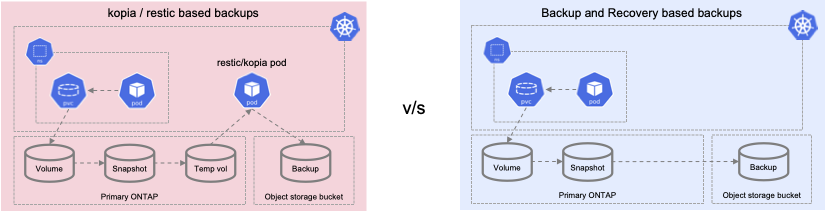
NetApp Backup and Recovery eliminates these dependencies on open-source data movers, and relies on NetApp SnapMirror for all backup data movement, which not only provides incremental forever backups, but also delivers Change Block Tracking (CBT) at a 4K block level without having to rescan and recompute all the PVCs and their last snapshots. We also eliminate the need to create temporary clones from volume snapshots solely to copy data to object storage buckets. When a backup is triggered, we use Kubernetes VolumeSnapshots to create ONTAP volume snapshots, then use SnapMirror and SnapMirror S3 to transfer only changed blocks to a secondary ONTAP system and/or object storage bucket based on the configured protection policy. Because this flow also preserves ONTAP storage efficiencies, it helps reduce the amount of data that needs to be transferred and the backup storage capacity needed, helping lower the overall cost of your data protection stack.
Seamless upgrade path for existing Trident protect customers
Based on Preview feedback we have added support for onboarding existing Trident protect clusters into NetApp Backup and Recovery. During onboarding, the service discovers existing application definitions and recovery points created with restic/kopia-based workflows. After discovery, you re-protect applications by assigning a protection policy. Existing recovery points remain available for restore to same or a different Kubernetes cluster using Kubernetes CR based workflows or through NetApp Console.
Conclusion and getting started
NetApp Backup and Recovery delivers differentiated protection for NetApp customers modernizing applications with containers and standardizing on OpenShift Virtualization for VMs. With incremental-forever backups (with CBT), preserved ONTAP storage efficiency, backup offload through SnapMirror, multi-cluster operations (UI and Kubernetes CR workflows), and role-based access control (RBAC), storage and backup admins can reduce operational burden while meeting availability and compliance SLAs.
This GA release is a foundation, and we’re continuing to expand capabilities throughout 2026. To learn more, visit the Backup and Recovery product page.
Try the service today. To start a free 30-day trial go to the NetApp Console and select Backup and Recovery under the Protection menu, then onboard your Kubernetes cluster and apply a protection policy to your first application or VM.
