Organizations migrating workloads from data centers or other hyperscalers to Amazon Web Services (AWS) often share a common challenge: How to assess and optimize what the future deployment and its end-state architecture will look like from the earliest stages of the planning cycle.
Making decisions about your post-migration storage architecture without accurate, workload-specific data can result in a deployment that misses performance expectations or introduces unnecessary long-term costs. What architects and IT teams need first is clarity: A precise view of existing workloads, their storage behavior, and how different AWS storage options compare under real-world conditions.
Now, all of that is possible with the new integration between Amazon FSx for NetApp ONTAP (FSx for ONTAP) and Matilda Cloud, the AI-powered platform designed to automate and accelerate application modernization, and management. In this post we’ll explore this new integration and see how it combines automated, AI-based environment discovery with storage-specific modeling. It’s a data-driven approach to evaluating storage options when moving workloads—in particular VMware virtual machines and databases—to AWS. This combined approach can drive cost savings of as much as 30-40%.
Here’s what we’ll cover:
The need for a realistic pre-migration storage assessment
How Matilda Cloud and FSx for ONTAP make workload migration assessments easier
The benefits of the data-driven storage assessment provided by Matilda Cloud and FSx for ONTAP
Get better insights into your migration to AWS with Matilda Cloud
The need for a realistic pre-migration storage assessment
The difference between a successful cloud migration and an expensive rework can come down to one critical decision: choosing the right storage architecture. Assessment tooling that thoroughly profiles the existing environment and recommends the best option in AWS is imperative.
During migration assessments, teams are expected to compare enterprise-grade storage capabilities with AWS services while estimating the performance rates and total cost of ownership (TCO).
Doing this manually can be challenging, because it requires detailed understanding of workload behavior, storage features, and knowledge of the technical details and pricing models of the AWS services involved. The task becomes even more complex when teams must evaluate multiple AWS service options. At worst, migration might result in a non-optimized storage or platform, which would require a second migration with increased risks, complexity, and expenses.
Obviously, meeting resilience and performance features is imperative, and cost optimization is always a factor that comes into play in the target environment. But migrating workloads such as databases and VMware environments come with further complexity. VMWare environments rely on shared datastores that support mixed workloads with a range of performance requirements. Database workloads usually have requirements around the consistency of input/output operations per second (IOPS) and latency sensitivity.
For example, a data center running VMware clusters and database servers might store years of infrequently accessed data alongside active, performance-intensive datasets. Without the ability to tier data to low-cost capacity pools or other storage efficiency features, teams risk provisioning high-performance storage for all data on AWS, which can drive higher costs over time.
The reality in the trenches is that architects still rely on basic methods such as spreadsheets and generic assessment tools to estimate migration TCO under different configuration scenarios. These methods struggle to account for enterprise storage features and possible additional investments that would need to be made to mitigate the gaps.
One example is customers who migrate their production databases from an on-premises VMWare environment that now has to consider the costs for their disaster recovery solution. An incomplete comparison of the pre-migration state results in both operational impact and long-term cost differences between storage architectures.
How Matilda Cloud and FSx for ONTAP simplify workload migration assessments
Matilda Cloud delivers AI-powered discovery and assessment capabilities designed specifically for VMware and database environments following three key automated steps:
- Discovery: Matilda’s automated tools discover your current environment (VMware, physical servers, databases) and map application dependencies.
- Analysis: The platform analyzes your applications and infrastructure, with special focus on configuration metadata, historical performance metrics, and storage consumption patterns across the estate.
- Modeling: It models the deployment with all AWS storage options, showing side-by-side comparisons and applying intelligent sizing logic to recommend the best fit for purpose service.
The Matilda assessment provides block and file volumes, workload density, IOPS and throughput demand profiles, and insights into how capacity will be consumed and retained over time. The result is a workload-level baseline that reflects how storage is used, rather than how it was originally provisioned.
FSx for ONTAP is an AWS storage service that provides file and block storage within a single AWS service, supporting Network File System (NFS), Server Message Block (SMB), iSCSI, and Amazon S3 compatible access. The service includes enterprise storage capabilities such as NetApp® Snapshot™ technology, lightweight cloning, simultaneous multiprotocol access, and built-in storage efficiency features. These capabilities influence performance design, data placement, and long-term cost outcomes, particularly for VMware and database workloads such as Microsoft SQL Server and Oracle, which depend on consistent latency and predictable I/O behavior.
The integration between Matilda Cloud and FSx for ONTAP extends Matilda’s baseline assessment into a storage-aware modeling phase for AWS. Instead of applying generic sizing ratios, Matilda maps observed workload behavior directly to FSx for ONTAP configuration constructs.
As part of the assessment, Matilda incorporates FSx for ONTAP capabilities directly into the modeled architecture. Storage efficiency assumptions, data tiering behavior, and workload-specific performance characteristics are evaluated as first-order design inputs.
This avoids treating enterprise storage features as post-migration optimizations by having to acquire additional third-party or custom-developed solutions to fill those gaps discovered afterwards. Instead, the assessment reflects how they shape capacity planning, performance headroom, and operational workflows from day one using FSx for ONTAP on AWS.
The first AWS Migration Acceleration Program certified tool to work with FSx for ONTAP
Matilda Cloud is the first AWS Migration Acceleration Program (MAP) certified tool to integrate with FSx for ONTAP. This integration is designed for storage-focused assessments, complementing specialized accelerator programs, such as MAP for VMWare. This certification aligns the assessment with AWS-recommended migration frameworks while extending them with storage-specific intelligence that is often missing from traditional migration analysis.
The output of the integration is a detailed assessment report that presents a direct comparison between all AWS storage services, including FSx for ONTAP. The report includes modeled cost estimates, configuration assumptions, and qualitative comparisons of storage capabilities, providing a clear, defensible foundation for architectural decision-making.
The benefits of the data-driven storage assessment provided by Matilda Cloud and FSx for ONTAP
By grounding architectural choices in workload-level data and storage-aware modeling, the assessment provided by Matilda Cloud and FSx for ONTAP leads to clearer insights around cost, performance, and operational efficiency.
- Trust in migration strategy and architectural choices
The Matilda Cloud assessment supports organizations as they evaluate performance and resilience requirements. Users can commit to migration or architecture decisions with certainty before deploying any new infrastructure on AWS. This approach leads to more decisive actions by removing uncertainty during the planning phase and shortening the decision cycles for migration projects.
- Clear visibility into cost and efficiency
The comparative reports provide quantifiable insight into cost drivers across different storage options and decrease the risk of additional storage migration projects after the transition to cloud. In anonymized customer assessments conducted using Matilda Cloud, FSx for ONTAP configurations have shown cost advantages of more than 30% compared to alternative AWS storage options depending on workload characteristics and data access patterns.
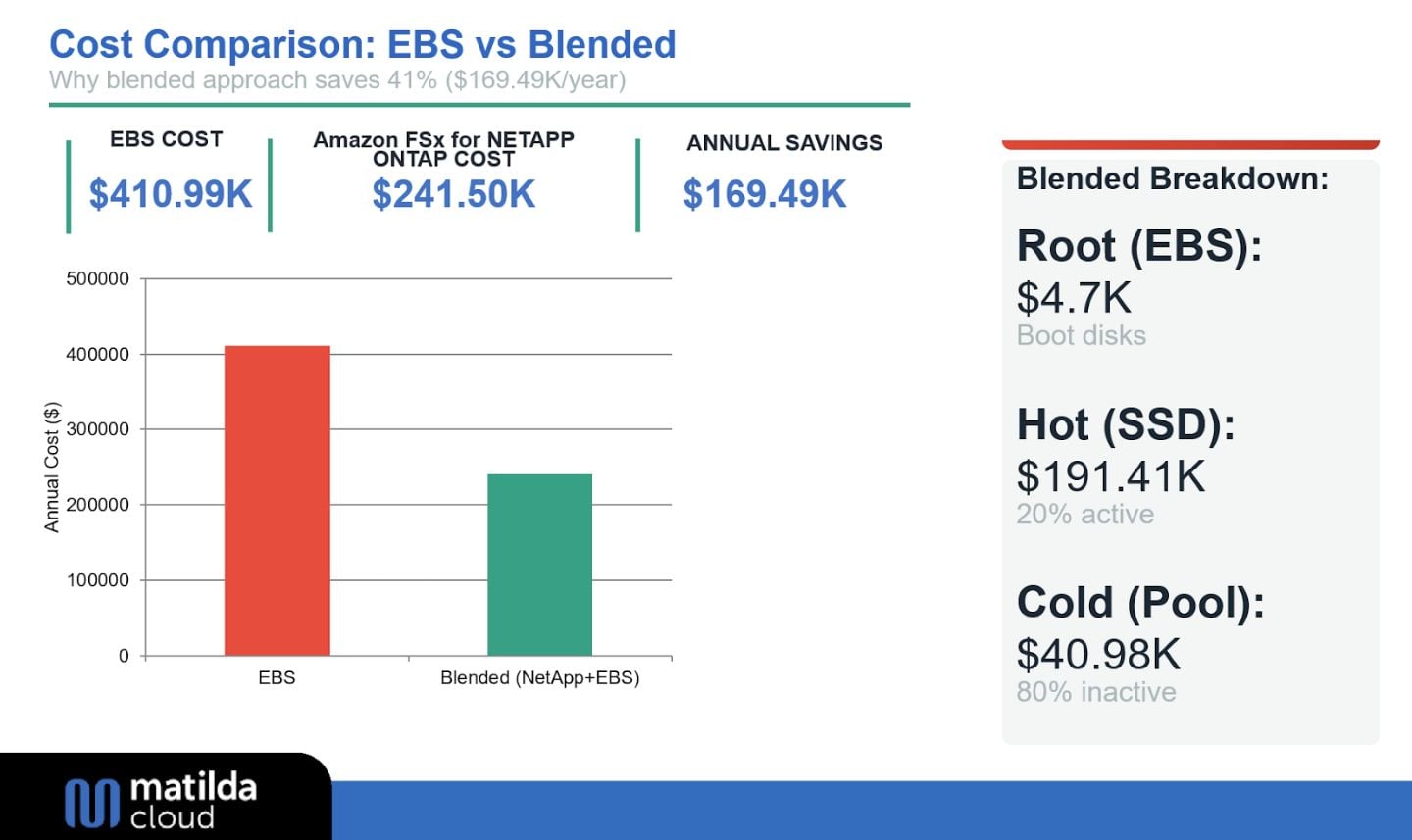
The following Matilda assessment provides a cost comparison between using FSx for ONTAP and Amazon Elastic Block Store (Amazon EBS). The blended architecture Matilda evaluates here uses Amazon EBS for root system volumes and FSx for ONTAP for data volumes across both primary and capacity storage tiers.
- Evaluate your enterprise storage features upfront
The assessment highlights the operational value of enterprise storage capabilities through the all-important lens of cost savings. Features such as cloning, data tiering, and multiprotocol access are evaluated during the planning stage, rather than leaving your team to discover them after migration and having to pay to fix them later.
This forward-thinking assessment style helps teams understand the practical impact of advanced storage functionality before deployment. In the screenshot below, a Matilda Cloud assessment has identified $7.4M in annual storage waste across eight inefficiency patterns, along with $2.8M in potential recoverable savings by using FSx for ONTAP in one quarter:
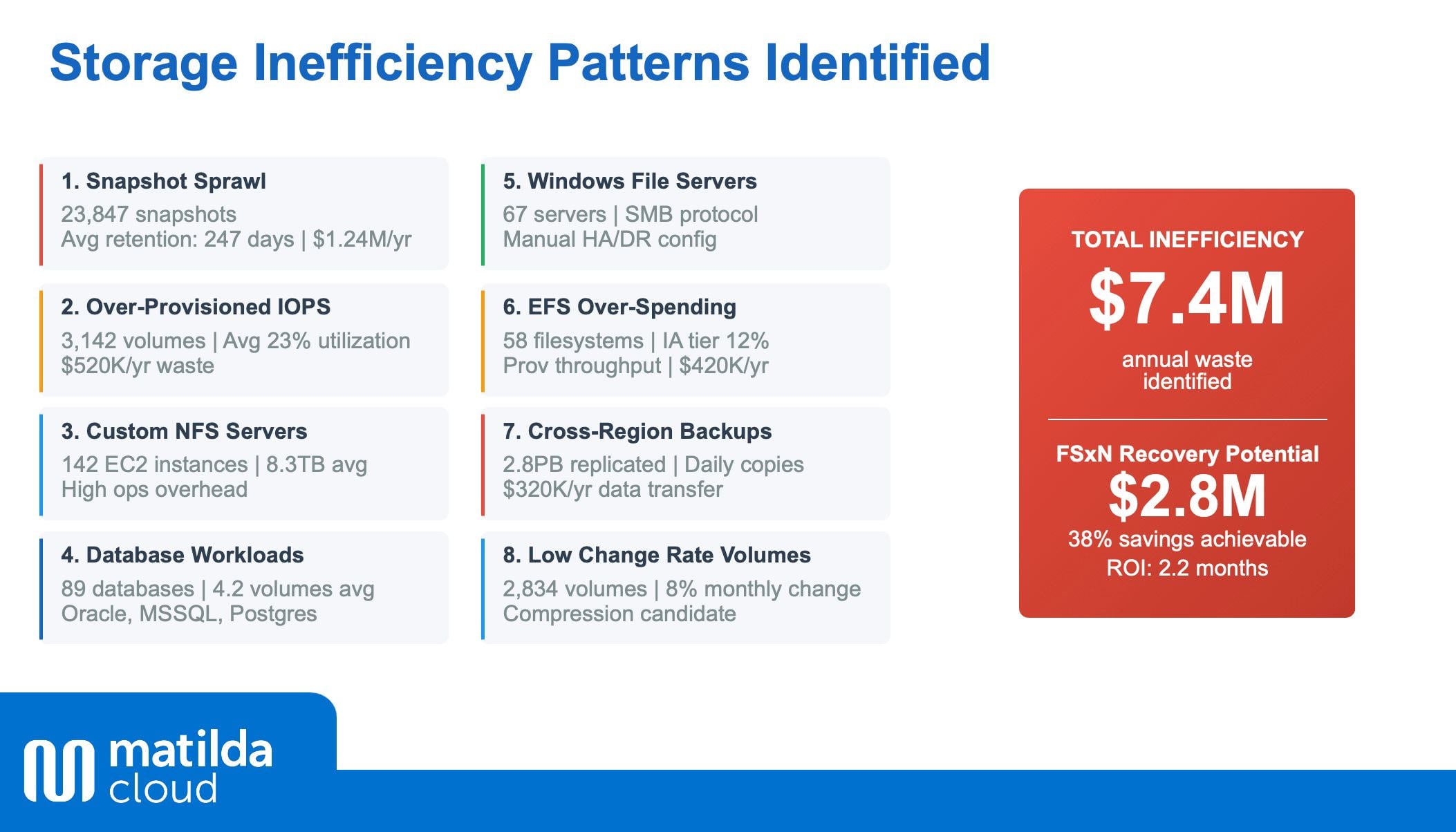
The insights from this assessment highlight several common infrastructure challenges that often remain hidden during manual migration planning. These include Snapshot sprawl, over-provisioned IOPS, volumes with low change rates, and the overhead of maintaining custom-developed solutions like self-managed NFS servers and backup tools. By addressing these factors, the Matilda assessment identifies a potential 38% in cost savings and a return on investment (ROI) in under 3 months.
Get better insights into your migration to AWS with Matilda Cloud
Successful migrations from data centers or other hyperscalers to AWS depend on making the right storage decisions early. The integration between Matilda Cloud and FSx for ONTAP introduces an objective, assessment-driven approach that helps organizations compare storage options with clarity and confidence.
By combining automated discovery with storage-aware modeling, teams gain the insight needed to streamline migration planning and align architecture with real workload requirements.
Learn more about the Matilda and NetApp integration in our joint webinar, or contact Matilda Cloud to check AWS-funded assessment options for your VMWare workloads.