In Part 1 and Part 2, we established “the brain” (the AI agent that reasons and decides) and “the hands” (MCP, the structured interface that lets the agent act). But brains can hallucinate. Hands can overreach. That is why every agentic architecture needs a shield — the layer that protects data, enforces boundaries, and ensures recoverability when something goes wrong.
NetApp is that shield.
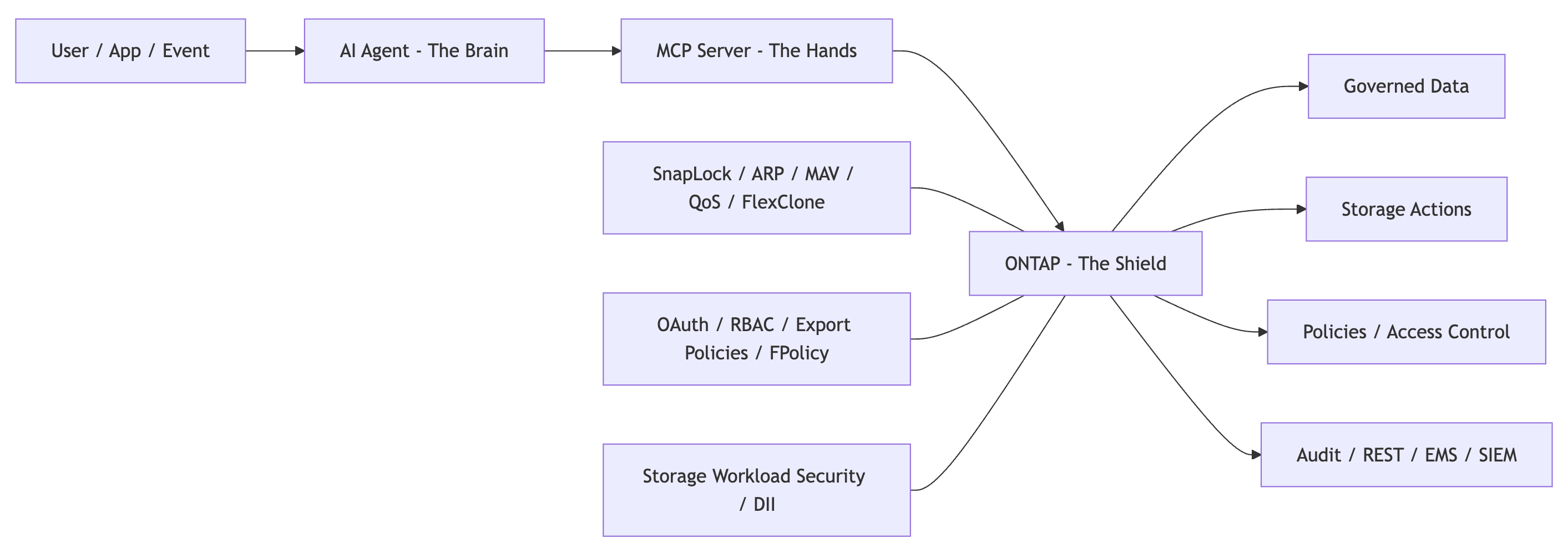
NetApp storage is not just the place where the data sits. It is the data foundation, operational control surface, and protection layer that makes agentic workflows viable in production. The shield provides four critical functions:
- Governance: Controlling what the agent can access and modify
- Protection: Ensuring data integrity and immutability regardless of what the agent does
- Visibility: Recording every action for audit, investigation, and compliance
- Recovery: Guaranteeing the ability to roll back when an agent makes a mistake or is compromised
Without this shield, you are trusting AI agents to never make a bad decision and the MCP to never execute a harmful action. In enterprise environments, that is not a bet anyone should take.
The OWASP Agentic AI Threat Model
OWASP helps customers understand how risks can be systematically reduced when the data layer, the control plane, and the recovery model are designed correctly. Here is how the key OWASP threat categories map to NetApp's shield:
Memory poisoning & cascading hallucinations
The risk: An agent's context or memory is corrupted through prompt injection, poisoned retrieval data, or accumulated reasoning errors. This leads to bad decisions that cascade across multiple operations. An agent might delete the wrong volumes, apply incorrect policies, or provision resources based on fabricated context.
How the shield helps:
- Tamper-proof snapshots and SnapLock provide immutable recovery points. Even if an agent acts on corrupted reasoning, the data can be rolled back to a known-good state. SnapLock adds WORM immutability for files and snapshots and supports both NFS and CIFS workflows, making it highly relevant for protecting logs, preserved outputs, training datasets, and sensitive workflow artifacts.
- Autonomous Ransomware Protection (ARP) detects anomalous data patterns in real time and automatically creates locked recovery snapshots. ARP has been available since ONTAP 9.10.1 for NAS workloads, and beginning with ONTAP 9.18.1, ARP is enabled by default on new volumes for supported AFF A-Series, AFF C-Series, ASA, and ASA r2 systems.
- FlexClone enables instant, space-efficient copies of production data. Agents can be directed to operate on cloned datasets rather than production volumes, containing the blast radius of any corrupted operation.
Tool misuse & privilege compromise
The risk: An agent invokes tools it should not have access to, escalates its own privileges, or uses legitimate tools in unintended ways. Some examples include resizing a volume to an absurd capacity, deleting snapshots that serve as backup recovery points, or modifying export policies to expose data to unauthorized networks.
How the Shield helps:
- ONTAP REST RBAC provides granular, role-based access control for every API endpoint. Agent identities can be scoped to only the specific operations they need, so that a provisioning agent does not get snapshot deletion permissions, and a monitoring agent does not receive write access at all.
- OAuth 2.0 (available since ONTAP 9.14.1) enables token-based authentication with scoped permissions, eliminating the need for long-lived administrative credentials. OAuth tokens can be time-limited and tied to specific REST roles.
- Multi-Admin Verification (MAV) (available since ONTAP 9.11.1) requires approval from additional administrators before certain sensitive or destructive operations are completed. This is especially powerful for agentic workflows. The agent can initiate a request, but a human must approve it before ONTAP executes it. Examples include:
- Volume deletion
- Snapshot policy changes
- SnapLock configuration modifications
- Cluster peering changes
- MCP --read-only mode ensures that only non-mutating tools are registered, providing an additional layer of constraint at the interface level before requests even reach ONTAP.
- QoS (Quality of Service) policies prevent an agent from consuming excessive storage performance resources, even if it has provisioning permissions. Rate limits and throughput ceilings contain the operational impact of runaway agent behavior.
Identity spoofing & rogue agents
The risk: An unauthorized agent impersonates a legitimate one, or a legitimate agent is compromised and begins acting outside its intended scope making unauthorized API calls, exfiltrating data, or modifying infrastructure without proper authorization.
How the Shield helps:
- OAuth 2.0 with named client identities ensures that every agent session is tied to a verifiable identity. ONTAP can distinguish between different agent identities and enforce different permission sets for each.
- MCP Secret Wrappers eliminates static credentials on the MCP host, reducing the attack surface if the agent's runtime environment is compromised. (these are an open-source security tool that eliminates hardcoded credentials for MCP servers
- ONTAP audit logs capture the authenticated identity behind every management operation. If a rogue agent makes API calls, the identity trail is preserved for forensic investigation.
- REST API logs provide the exact API calls, parameters, and responses, creating a machine-readable record that can be correlated with expected agent behavior patterns.
- EMS (Event Management System) generates security-relevant events for authentication failures, authorization denials, and configuration changes. Repeated authorization failures from an agent identity are a strong signal of spoofing or compromise.
- Storage Workload Security in Data Infrastructure Insights provides centralized visibility into data access patterns, anomaly detection, and behavioral analysis across environments. This is particularly valuable for detecting rogue agent activity that might appear legitimate at the individual API call level but reveals suspicious patterns when audited holistically.
Lack of traceability & accountability
The risk: An agent takes actions on infrastructure, but there is no way to determine what it did, when, under what identity, or why. This makes incident response impossible. Compliance audits fail, and trust in automation erodes.
How the Shield helps: ONTAP provides three complementary logging layers:
- Audit Logs: Who did what, when, and whether it succeeded
- REST API Logs: Exact API calls, parameters, job status, and errors
- EMS Events: Operational and security events with alerting and forwarding capabilities
All three can be forwarded to external SIEM/SOC platforms, enabling security teams to monitor AI agent activity alongside other enterprise operations. This transforms agentic workflows from opaque automation into fully observable, auditable operations.
OWASP threats vs. NetApp capabilities
OWASP Threat Category | NetApp Shield Controls |
Memory Poisoning / Cascading Hallucinations | Tamper-proof Snapshots, SnapLock (WORM), ARP, FlexClone for isolated operations |
Tool Misuse / Privilege Compromise | REST RBAC, OAuth 2.0, MAV (multi-admin approval), MCP read-only mode, QoS policies |
Identity Spoofing / Rogue Agents | OAuth 2.0 named identities, Secret Wrapper, Audit Logs, EMS security events, Storage Workload Security |
Lack of Traceability | Audit Logs, REST API Logs, EMS Events, SIEM/SOC forwarding |
Data Exfiltration / Unauthorized Access | Export policies, RBAC scoping, SnapLock, Storage Workload Security anomaly detection |
Denial of Service / Resource Abuse | QoS policies, MAV for destructive operations, ARP for anomalous patterns |
NetApp security: Feature reference
Here is a consolidated view of the NetApp capabilities that form “the shield” for agentic workflows:
Capability | What It Does | Agentic Relevance |
ONTAP REST RBAC | Granular role-based access control for every API endpoint | Scope agent permissions to least privilege |
OAuth 2.0 | Token-based authentication with scoped, time-limited permissions | Eliminate static credentials for agent identities |
Multi-Admin Verification | Require human approval for sensitive operations | Human-in-the-loop gate for destructive agent actions |
SnapLock | WORM immutability for files and snapshots | Protect logs, outputs, and datasets from agent modification |
Tamper-proof Snapshots | Immutable recovery points | Guaranteed rollback if an agent corrupts data |
Autonomous Ransomware Protection | Real-time anomaly detection with locked recovery snapshots | Catch and contain anomalous agent write/delete patterns |
FlexClone | Instant, space-efficient volume copies | Isolate agent operations from production data |
FlexCache | Distributed read caching for hot datasets | Improve data locality for AI pipelines without duplicating data |
QoS Policies | Throughput and IOPS limits per workload | Prevent agent resource abuse |
Export Policies | NFS/CIFS access rules per volume | Control which networks and hosts agents can access data from |
Audit Logs | Management operation logging | Identity-level accountability for every agent action |
REST API Logs | Detailed API call tracking | Machine-readable proof of every operation |
EMS Events | Operational and security event system | Anomaly detection and real-time alerting |
Storage Workload Security | Behavioral analytics and anomaly detection in DII | Holistic visibility into agent data access patterns |
MCP Read-Only Mode | Register only non-mutating tools | Discovery-first deployments without write risk |
MCP Secret Wrapper | Inject credentials from vaults without local persistence | Reduce credential exposure on agent hosts |
SnapMirror | Asynchronous and synchronous replication | Disaster recovery for agent-managed data |
FPolicy | File access monitoring and control | Data-access-level auditing beyond management operations |
Attribute Based Access Control | Utilized NFS 4.2 xAttrs and MAC labels as well as Windows Dynamic Access Control (DAC) to enforce access control based on unique attributes and classification | Prevents an agent from accessing sensitive data that it doesn’t have the correct classification for even if the permissions are incorrect or changed to allow access. |
Example workflow
A practical example that exercises the full Shield:
"Provision a new training workspace, bring the required dataset closer to the GPU cluster, apply the standard protection policies, and show me exactly what changed."
In a NetApp-backed design:
- MCP provides the governed interface. The agent invokes scoped tools, not raw APIs.
- ONTAP RBAC and OAuth verify the agent's identity and confirm it has permission for each operation.
- MAV gates the provisioning request if the operation is classified as sensitive, requiring human approval before execution.
- ONTAP handles the volume creation and policy application.
- FlexCache brings the dataset closer to the GPU cluster, improving read performance without duplicating data.
- ARP begins monitoring the new volume for anomalous access patterns.
- Snapshot policies are applied automatically, creating immutable recovery points.
- Audit Logs, REST API Logs, and EMS Events capture every step — who requested it, what was executed, and whether it succeeded.
- Storage Workload Security provides ongoing behavioral visibility into how the workspace is accessed.
The agent acted. NetApp ensured it acted safely, within bounds, and with a full record of everything that happened.
Key takeaways
The “brain” (AI agents) reasons. The “hands” (MCP) execute. But, it is the “shield” (NetApp’s built-in security) that empowers the entire architecture to operate with confidence.
NetApp does not just secure AI agent workflows, it empowers them. By providing governed storage services, intelligent data placement, and supported APIs, NetApp gives agents a real enterprise foundation to act on. By surrounding those same workflows with immutability, anomaly detection, multi-admin approval gates, granular access control, and end-to-end traceability, organizations gain the confidence to let agents operate. NetApp’s “shield” does not replace good AI design, but it ensures that when an agent acts on enterprise infrastructure, the data layer is ready with governance, protection, visibility, and recovery at every step. Overall, NetApp empowers AI agents — not by removing guardrails, but by building the right ones so agents can move faster, act safely, and earn trust in production.
Part 4 - Provides best practices and Implementation checklist guide
Here are links to all the parts of this blog series.
Blog Intro - Running AI agents on NetApp: Securely, practically, and without surprises
Part 1 — What an AI agent actually is, and why the data layer decides whether it succeeds
Part 2 — What is an MCP Server and why does it matter?
Part 3 — How NetApp empowers AI Agentic workflows
Part 4 — Configuring your NetApp infrastructure for AI agents